Odaa: Gaadisaa Gada! Where Truth Takes Root
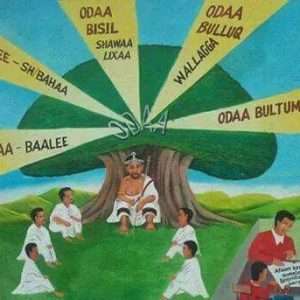
The Odaa tree, or Sycamore, stands as a powerful symbol in Oromo culture. It is under the shadow of Odaa Tree that The polymaths of the Oromo people who invented, developed, a unique system called Gadaa (in Oromoo and correct writing and pronounced long a’s) nevertheless it was often written with short a in English Gada. more than just a tree; it represents life, wisdom, and the very foundations of their ancient society.
According to life-long organic teacher Dr. Gamachuu Mageaarrisa and Aneesa Kassam, authors of the unique seminal work Sacred Knowledge Traditions of The Oromo of The Horn of Africa stated:
It was during the Bidir/Dhoqqee period (4489-1249) which preceded the era that closed in 1991, is said to have lasted nine great rounds (360 ) of time, together, these two great rounds (3240 +3240) total 6,480 years. It was during Bidir -Dhoqqe period that twin institutions of the nation , the Gadaa and the Qalluu, were progressively forged and during which the cardinal law (yaaya shanan) governing the society were formulated by the five ancestral law-makers. During this period, the five territorial groups were governed from a single political-religious center, headed by Abbaa Muudaa shaman priest king, to whom tributes was paid. The first sacral center is said to have been located along the Blue Nile (Abbayyi) at, or near, lake Tana.
The phrase “Only Truth has a seat under the Sycamore Tree” encapsulates the profound significance of this sacred space. It suggests that true knowledge and understanding are found not in abstract theories or borrowed narratives, but in the authentic wisdom passed down through generations, rooted in the land and the lived experiences of the Oromo people.
It has gone through ethnocides by the Habeshas, later known as Abyssinia settlers fake “Ethiopians” since thier feet held on Africa soil.
For those who have been taught a distorted version of history, packaged as “education,” it is crucial to unlearn and re-evaluate, stresses the importance of reclaiming the wisdom of the Oromo people, particularly for those who have been indoctrinated with foreign-influenced perspectives. It urges a return to the teachings and principles embodied by the Odaa tree.
Under the shade of the Odaa, the Gada system was born and flourished. This sophisticated, indigenous democratic system, recognized by UNESCO in 2016 as an Intangible Cultural Heritage of Humanity, is a testament to the Oromo people’s enduring legacy.
The Gada system demonstrates a profound understanding of governance, social organization, and the cyclical nature of time
By revisiting and understanding the “encyclopedia retained under the Odaa Tree,” the Oromo people can reconnect with their authentic heritage, their true history, and the wisdom that has sustained them for millennia. It is a call to reclaim their narrative, to celebrate their cultural identity, and to reaffirm the power of truth rooted in the land and embodied by the sacred Odaa.
Odaa
yaa muuka rajii,
angafaa hundaa
muukaa gudaa;
muuka jabba
muukaa dagaagaa;
kabbajaama,
muukaa dibaabo
baalii cuuluqisa magaarriisa,
muuka filama, hunda caala jaalatama.
asxaa tookuuma
agoobara Oromummaa
dawoo dhugaa
Oromoon Gaadisaa keeti
heera fi seera
sirna jaarsuuma
sirna aaraara
aaraara haqaa
sirna jaarsuma,
sirna naga’aa
sirna diimokraataawa dhugaa
dhugaa quulqulawa
tummee lalabaa.
dhaga’ee dhageechise,
kabajaan ittin walinbula
Gadaa
sirna aduunyan dinqisifaate
Kan Ambaa aada hin qaqqabamneeti
UNESCOn eebistte galmeefatee kan
kan Oromoon, siitii boonu
sii iittisa, sii dagaagsa
ittin of himmuu